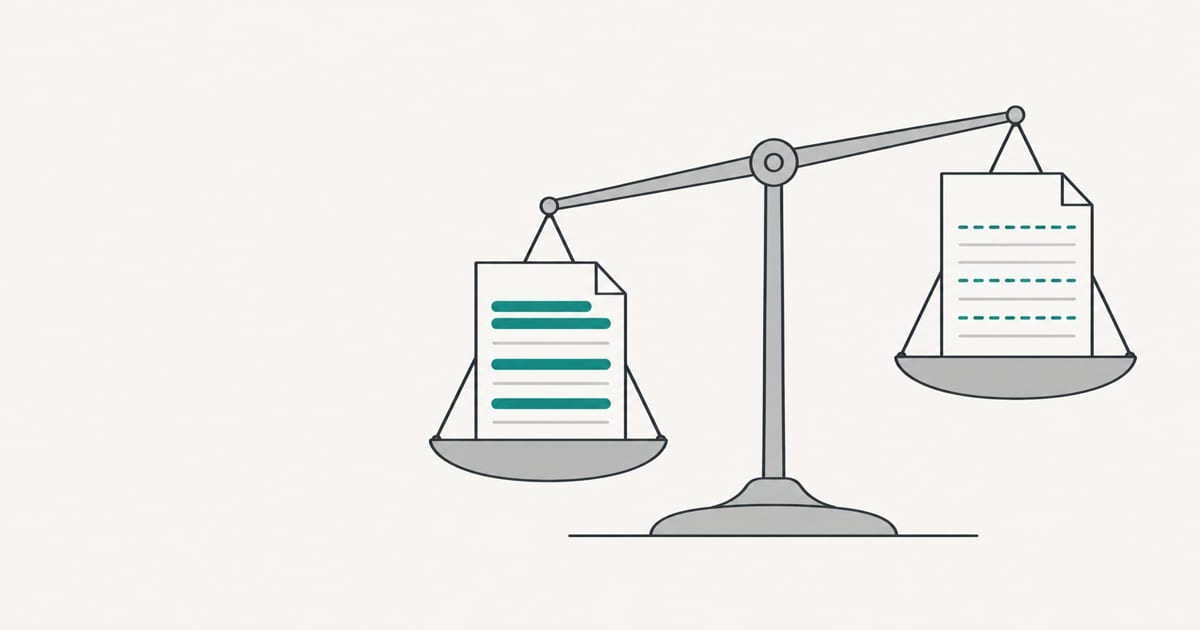
Yes. Every AI detector, including the one on this site, can label human writing as AI-like and can miss text that a model produced. Understanding how these errors happen is the difference between using a result sensibly and being misled by it.
Key takeaways
- Two kinds of mistakes exist: human text flagged as AI-like (a false positive) and AI text that passes as human (a false negative).
- Short, formal, translated, non-native or heavily edited writing is where results are least dependable.
- A detector labels passages. It does not know who wrote the text or how.
- A result should start a conversation, never end one. Do not penalize anyone on a detector result alone.
The two kinds of error
A false positive is human-written text that a detector labels as AI-like. A false negative is machine-generated text that a detector labels as human. They matter in different ways. A false positive can harm a person who did nothing wrong, such as a student or a freelancer. A false negative means a tool has missed something it was meant to catch.
No detector can remove both errors at once. Making a tool more cautious about flagging lowers false positives and raises false negatives, and the reverse. Any honest claim about performance depends on the kind of text, the language, the models that produced it and where the line is drawn. That is why we do not quote a single accuracy figure, and why our accuracy page describes what we can and cannot claim instead. For what independent studies have found about how often detectors err, see how accurate AI detectors are; for the student-writing case, see AI detection false positives.
Why detectors make mistakes
A detector is a statistical classifier. It has learned, from many examples of human and machine writing, to assign labels to passages. Our checker uses the Pangram Labs API, which labels each passage as AI-Generated, AI-Assisted or Human Written with a confidence level. The service returns labels; it does not return reasons. That has two consequences.
First, a label is a judgment about resemblance to patterns seen in training, not about authorship. Text can resemble those patterns for reasons that have nothing to do with a model.
Second, the training data is never a complete picture of how people write. New models appear, writing habits shift and many human genres are underrepresented. A detector that performs well on one kind of text can do worse on another.
Writing that is more likely to be misjudged
Some categories deserve extra care. These are well-known weak spots for the field in general, not special features of one product.
Short text. A detector needs enough material to find a pattern. With a few sentences, one unusual choice can dominate the result. We require at least 50 words and treat anything near that minimum as thin evidence.
Formal or conventional writing. Abstracts, legal clauses, reference letters, press releases and standard operating procedures follow tight conventions. Human writers produce uniform, impersonal prose in these genres all the time.
Non-native English. Writers working in a second language often favor common vocabulary and safe sentence structures. A classifier looking for regular patterns can read that regularity as machine-like. Because of this, be cautious when applying any detector to work by multilingual writers.
Translated text. Translation, whether by a person or software, changes word choice and rhythm. A human essay translated into English may not look like a typical native English draft.
Edited or mixed text. A person who drafts by hand and then runs a paragraph through a grammar tool or an AI rewriting assistant has produced something in between. Our result labels passages as AI-Assisted for exactly this reason, but the boundary is blurry and the labels are only as good as the classifier’s training.
Non-English text. Detection is most reliable for English. Results on other languages should be treated as even less certain.
A worked example
Suppose a graduate student submits a 120-word abstract. The conventions of abstracts, with a fixed order of background, method, finding and implication, produce tidy, impersonal sentences. A detector may mark several of them as AI-like because they are consistent and generic, and the writer is a non-native English speaker who deliberately used plain, safe phrasing.
The result might read “Mixed signals” with a modest share flagged. If the reader treats that as an accusation, an innocent person is in trouble. If the reader treats it as a prompt, they ask for notes and drafts, check the sources and talk to the student, and the matter resolves in minutes.
Now reverse it. A user prompts a model to write an essay, then rewrites every third sentence by hand and swaps in synonyms. The detector may label little of it as AI-like. That is a false negative, and it is why a clean result is not proof of human authorship either.
How to read a result responsibly
- Check the length. Under a couple of hundred words, assume the result is rough.
- Check the highlights, not just the headline. Read the flagged sentences. Ask whether they are generic, conventional or simply well-polished.
- Consider the writer. Is this a language learner, a specialist in a formal field, or someone who uses editing tools openly?
- Look for other evidence. Drafts, version history, sources and a conversation are all stronger than a score.
- Remember what the number is. On this site, “Flagged as AI-like” is the share of passages labeled AI-like, not a probability that the whole text is AI. What an AI detection percentage means walks through the difference.
What we do not claim
We do not say our checker is always right, that any particular score proves misuse or that a clean result proves a person wrote something. We do not explain why a passage was flagged, because the detector does not tell us. The methodology page lists what we analyze, and how AI detection works describes the general approach in plain language.
If a result about your own writing looks wrong
If you wrote a text yourself and a detector flags it, you are not alone, and it is not necessarily a sign that you wrote badly. Keep your outline, drafts and notes, and know where your sources came from. If someone is questioning your work on the strength of a detector result, you can reasonably ask what other evidence exists and point out that detection tools are known to produce false positives, particularly on short, formal and non-native writing. If you want a second look at your own text, you can run it through the text detector and see which sentences are highlighted, then judge for yourself whether they point to anything real. Why your writing may show as AI goes through the common causes and how to respond calmly.
For educators and editors
If you are the one deciding, use the result as one signal among several. The page for teachers explains how to review highlights alongside a student’s other work, and how to tell if text is AI-generated covers the checks that carry more weight than any score. A fair process gives the writer a chance to explain before any consequence follows. What to do when a detector flags student writing sets that process out step by step.